"Prior to 1991 the complex was primarily visited only by the Pa’oh and was largely obscured from the larger world, to the extent that even in Taunggyi the general population was unaware of its location or existence" - Liljeblad 2016.
Descrição do Site
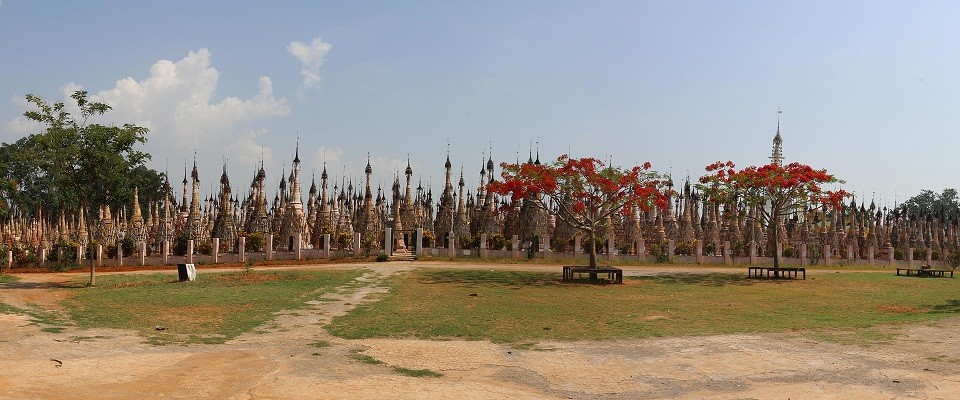
Kakku is a remarkable sacred natural site, housing at least 2478 pagodas and a large number of sacred Bodhi trees. It is located in the Shan state in Myanmar, southeast of the city Taunggyi. Some say it is built as a shrine for the passage of the dead. Others claim that King Alaung Sithu built the site as a resting point for river travelers. Others yet see the location as having substantial spiritual properties, based on its astrology. All stories share their respect for the present sacred endemic Bohdi tree. The site currently faces the threat of being highly altered by tourism, something the government tries to stimulate. To mitigate this process, the local gawbaka committee creates ways to promote the local culture and raise awareness on their spirituality.
Ameaças
Threats to the biodiversity in the region include hunting and poaching, agricultural use of natural forests, shifts in cultivation methods, destructive fishing methods, introduction of invasive species and weak law enforcement against illegal activities such as wildlife trade.
Meanwhile, economic incentives such as development pressure and increased tourism drive local communities to concessions. Examples in Kakku are recent establishment of strong roads, the conversion of forest into farmland, increased village sizes and establishment of a parking lot and a restaurant, all of which came at the cost of local wildlife. According to archaeologists, the pagodas are threatened by bad reconstruction materials, which do more damage on the long run. As for the cultural context, some argue that regarding the Kakku site as a monument to preserve undermines local people’s capacity to undergo cultural evolution, and detaches local culture and identity from the site.
Visão
There is an intrinsic conflict of visions between the World Heritage system and the lived reality of the Pa’oh people, concerning the way to document the Kakku site. The national level registration and documentation of the local values is prone to adopt globalising notions on indigenous spirituality. It anchors the values of indigenous communities and overlooks evolving, dynamic conceptions of values towards their sacred sites. It raises questions on who has the authority to determine the meaning of a sacred natural site, and if categorization is always the best approach.
Ação
The Pa’oh gawbaka exercises management of Kakku, and maintains an ongoing management approach towards Kakku involving regular consideration of site conditions and conservation policies. The jurisdiction of the gawbaka, contudo, is subject to an informal arrangement between the national and state governments with the Pa’oh, E a natureza desse arranjo pode mudar à medida que Mianmar continua sua transição política, que envolve possíveis mudanças em direção ao federalismo e mudanças de atendentes para comunidades étnicas indígenas.
Política e Direito
Como faz parte do país de Mianmar, A área possui uma variedade de leis de vida selvagem e de proteção do parque em vigor (Embora nem sempre seja aplicado adequadamente). Mais relevantes na discussão são as áreas protegidas da IUCN e as diretrizes do patrimônio cultural do ICOMOS, Porque eles estão mais focados na interação com os povos indígenas no local, e trabalhar para uma maior inclusão. De fato, Reformas recentes introduziram valores indígenas locais e autenticidade na fabricação de políticas, Mas a tendência de documentar e corrigir determinadas práticas pode ser limitadora para as tradições existentes e em evolução.
Ecology & Biodiversidade
Myanmar is part of the Indo-burma biodiversity hotspot, harbouring a vast number of north-south oriented biodiversity corridor ecosystems. Kakku is located near several bird and wildlife sanctuaries. The nearest Inle Wetland Bird Sanctuary, por exemplo, houses 345 espécies de aves, 59 espécies de peixes, about thirty reptiles and amphibians and about 184 orchids. It is also suspected to be a nesting site for the endangered Sarus crane (Grus antigone). The Bodhi tree (ficus religiosa) is the most important plant species with religious value, as it is said that Buddha attained enlightenment under it. Its parts are used against about 50 ailments.
Custodiantes
The local Pa’oh people claim to own the Kakku pagoda complex. They have an appointed committee, the gawbaka, who have the responsibility and authority to manage the site. While the site has strong Buddhist significance, Eles o expressam também tem significado espiritual e emocional na religião animista local, que vê a terra como um domínio de nats ou espíritos. As pessoas Pa'oh migraram para o local por volta do século 10 d.C.. Eles trataram o local como um ponto de encontro para as celebrações anuais e para expressar tradições compartilhadas, valores e significados.
O Gawbaka foi formado durante a construção da estrada para Kakku. Tem 47 Membros nomeados pelo ex -monge e líder político U Aung Kham HTI, com base em qualificações religiosas. As decisões são tomadas com base em consenso durante as reuniões mensais. A prioridade é colocada principalmente no significado cultural e religioso do local para o povo pa'oh, que continuam a usá -lo como um site para adoração, particularmente durante as férias pa'oh em março e novembro.
"Enquanto o Gawbaka insiste que Kakku não é um negócio e que evita o turismo, O comitê parece ter respondido à pressão do desenvolvimento ...… o resultado foi uma limpeza da vegetação e a vida selvagem acompanhante, um aumento na lixo, e um aumento de incidentes envolvendo turistas violando rituais e regras sagradas."
- Liljeblad 2016.
Trabalhando juntos
O gawbaka trabalha em conjunto com uma variedade de organizações governamentais e não-governamentais, incluindo o partido político PNO, o governo de Mianmar, entidades estrangeiras, Doadores particulares, Adoradores e outros visitantes. A principal preocupação das organizações governamentais é melhorar as condições socioeconômicas em Mianmar, e eles promovem o desenvolvimento rural, incluindo a indústria do turismo. De fato, o gawbaka reconhece os benefícios de tais desenvolvimentos.
Ferramentas de conservação
Para conservar a herança cultural de Kakku, o gawbaka o comitê aumentou a segurança para monitorar o comportamento do visitante. Eles também incentivam os monges a lembrar os visitantes de regras religiosas sobre o culto. Os turistas usam os guias do site para educá -los sobre o comportamento apropriado na área. Esses esforços promovem a cultura e as práticas espirituais pa'oh, mas não estão particularmente focados na conservação da natureza.
Resultados
Os Gawbaka sentem que até agora foram capazes de preservar o caráter sagrado de Kakku, particularmente em relação ao comportamento de turistas estrangeiros. Eles são, contudo, Preocupado com o gerenciamento de Kakku diante dos esforços para promover maior turismo e desenvolvimento socioeconômico, ambos aumentarão a pressão sobre o meio ambiente e os pagodes em Kakku.
"Meetings with the gawbaka indicate some uncertainty regarding the origins of Kakku… …As a spiritual site, they note that within the Pa’oh culture the site itself has a significance outside Buddhism, with the land seen as a domain of nats, or spirits in Pa’oh animist beliefs" - Liljeblad 2016.
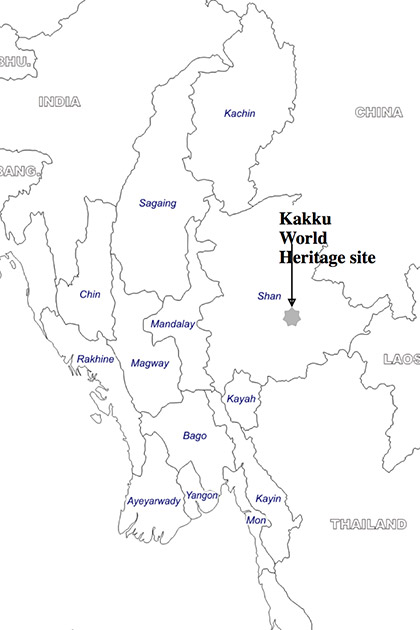 The approximate location of Kakku in southeast of Taunggyi in Shan State in Myanmar. (Fonte: D-maps adapted by Bas Verschuuren.)
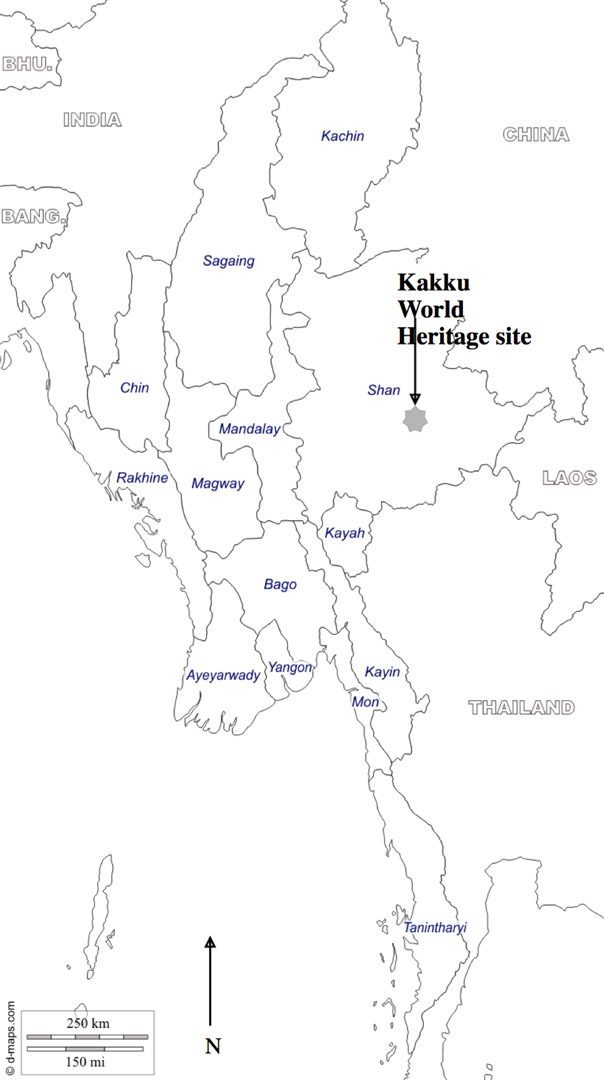
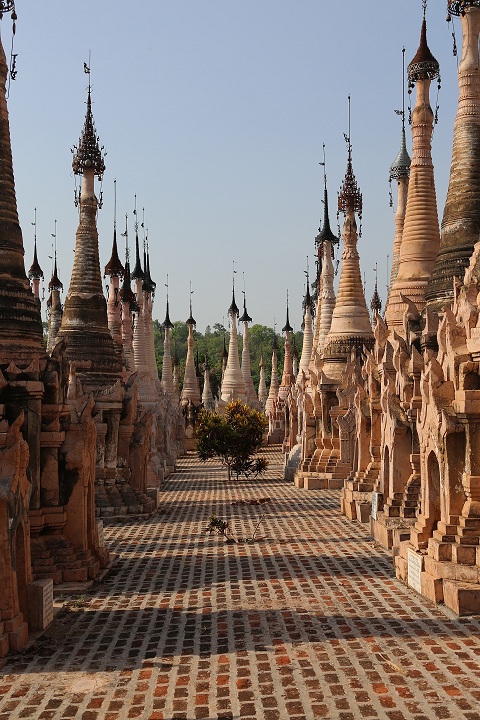 Kakku, close-up. The ground was originally dirt and the stupas were fallen, but in the past few decades under the gawbaka the ground was paved over with brick and each of the stupas has been repaired by devotees using different materials.
(Fonte: Marc Veraart.)
- Aung. Status of Biodiversity Conservation in Myanmar. Presentation for the CBD.
- Liljeblad, Jonathan. (2016) The Pa’oh’s Governance System and Kakku: Implications for Heritage Conservation from Burma/Myanmar, in Bas Verschuuren and Naoya Furuta (eds.), Asian Sagrados sítios naturais: Filosofia e Prática em Áreas Protegidas e Conservação. Routledge.
-
Contato:
Jonathan Liljeblad
Senior Lecturer, Law School
Swinburne University of Technology
H25 P.O. Caixa 218
Hawthorn, Victoria 3122 Austrália